

-
Learn Spanish for Beginners and Adults
- Learning Spanish Like Crazy Level One–New and Improved Version (Lessons 1 to 30)
- Narrated by: Diego Martinez, Liliana Sanchez
- Length: 21 hrs and 57 mins
Failed to add items
Add to Cart failed.
Add to Wish List failed.
Remove from wishlist failed.
Adding to library failed
Follow podcast failed
Unfollow podcast failed
 Prime members: New to Audible?
Get 2 free audiobooks during trial.

Learn Spanish for Beginners and Adults
Buy for $29.95
No default payment method selected.
We are sorry. We are not allowed to sell this product with the selected payment method

Listeners also enjoyed...

-
Learn Intermediate Spanish Bundle: The Ultimate Learning Intermediate Spanish Bundle
- Lessons 31 to 60 from Learning Spanish Like Crazy Level Two
- By: Patrick Jackson
- Narrated by: Jose Rivera, Juan Martinez, Jessica Ramos
- Length: 19 hrs and 35 mins
- Unabridged
-
Overall4.5 out of 5 stars 347
-
Performance4.5 out of 5 stars 268
-
Story4.5 out of 5 stars 261
This learn intermediate Spanish bundle program will teach you how to speak authentic Latin American conversational Spanish. Using only native Spanish speakers, this program will ensure that you develop an authentic Latin American Spanish accent. This bundle covers lessons 31 to 60. This learn Spanish intermediate bundle also puts a major emphasis on improving pronunciation.
-
5 out of 5 stars
-
Only one drawback in my opinion
- By Elizabeth Meyers on 10-29-18
By: Patrick Jackson

-
Learn Advanced Spanish Bundle: Includes Both New Version & Original Version of Learning Spanish Like Crazy Level Three
- The Ultimate Learning Advanced Spanish Bundle
- By: Patrick Jackson
- Narrated by: Jose Rivera, Juan Martinez, Jessica Ramos
- Length: 17 hrs and 1 min
- Unabridged
-
Overall5 out of 5 stars 197
-
Performance5 out of 5 stars 154
-
Story5 out of 5 stars 151
This program covers lessons 61 to 80 from the new version and lessons 61 to 75 from the original version of Learning Spanish Like Crazy Level Three. As a special gift, we’ve included bonus lessons A to D from Learning Spanish Like Crazy Level Three. We’ve also included four bonus lessons covering the Spanish prepositions Por and Para.
-
5 out of 5 stars
-
The best advanced level Spanish program
- By Keeley S. on 10-25-18
By: Patrick Jackson

-
Learn Spanish with Paul Noble for Beginners – Complete Course
- Spanish Made Easy with Your Personal Language Coach
- By: Paul Noble
- Narrated by: Paul Noble
- Length: 13 hrs and 21 mins
- Unabridged
-
Overall5 out of 5 stars 1,190
-
Performance5 out of 5 stars 981
-
Story4.5 out of 5 stars 929
No grammar tests. No memory drills. No chance of failure. Welcome to Learn with Paul Noble – a unique, tried and tested language learning method that has been used by almost a million people to speak fluently and confidently in no time at all. This course covers European and Latin American Spanish. Take a simple, relaxed approach to learning a language that has been proven to succeed every time. Unlike more traditional language learning courses, Paul Noble’s unique method has no grammar tests, no memory drills and no chance of failure.
-
5 out of 5 stars
-
Loved it! I feel like I learned a lot!
- By Marty on 06-25-19
By: Paul Noble

-
Easy Spanish Step-by-Step
- By: Barbara Bregstein
- Narrated by: Rachel Story
- Length: 37 hrs and 15 mins
- Unabridged
-
Overall4.5 out of 5 stars 29
-
Performance4 out of 5 stars 18
-
Story4 out of 5 stars 18
Easy Spanish Step-by-Step is designed in such a way that each section builds upon the last to help your brain progressively create lasting and meaningful connections to each new word and grammar concept. Simply by listening and speaking out loud with us, you will naturally progress, step-by-step, toward Spanish communication and fluency.
-
5 out of 5 stars
-
Best so far . . .
- By Medusa in Akron on 07-20-21
-
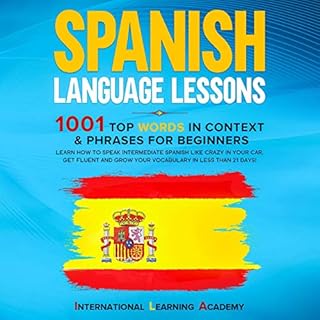
Spanish Language Lessons: 1001 Top Words in Context & Phrases for Beginners
- Learn How to Speak Intermediate Spanish Like Crazy in Your Car, Get Fluent and Grow Your Vocabulary in Less Than 21 Days!
- By: International Learning Academy
- Narrated by: Ana, Pacho
- Length: 7 hrs and 2 mins
- Unabridged
-
Overall5 out of 5 stars 206
-
Performance5 out of 5 stars 193
-
Story5 out of 5 stars 201
Inside this book, you’ll uncover the 1001 most common Spanish words, arming you with the knowledge you need to supercharge your language learning, expand your vocabulary, and learn in a fast, fun, and easy way. Plus, with each word in context, you’ll know how to fit them in a sentence, pronounce them correctly, and start speaking real, conversational Spanish in no time at all!
-
5 out of 5 stars
-
For focused studying
- By Julieta Lyle on 07-03-20

-
Next Steps in Spanish with Paul Noble for Intermediate Learners – Complete Course
- Spanish Made Easy with Your Personal Language Coach
- By: Paul Noble
- Narrated by: Paul Noble
- Length: 7 hrs and 41 mins
- Unabridged
-
Overall5 out of 5 stars 476
-
Performance5 out of 5 stars 397
-
Story5 out of 5 stars 377
Improve your Spanish the easy way at home, now is the time to take your Spanish to the next level! No books. No long lists of vocabulary. No chance of failure. Simply download, plug in and listen. Paul Noble’s tried and tested language learning method has been used independently by more than a million people to speak fluently and confidently.This course covers European and Latin American Spanish.
-
3 out of 5 stars
-
Uneven pacing, decent material
- By Jennifer on 05-03-20
By: Paul Noble
-
Learn Intermediate Spanish Bundle: The Ultimate Learning Intermediate Spanish Bundle
- Lessons 31 to 60 from Learning Spanish Like Crazy Level Two
- By: Patrick Jackson
- Narrated by: Jose Rivera, Juan Martinez, Jessica Ramos
- Length: 19 hrs and 35 mins
- Unabridged
-
Overall4.5 out of 5 stars 347
-
Performance4.5 out of 5 stars 268
-
Story4.5 out of 5 stars 261
This learn intermediate Spanish bundle program will teach you how to speak authentic Latin American conversational Spanish. Using only native Spanish speakers, this program will ensure that you develop an authentic Latin American Spanish accent. This bundle covers lessons 31 to 60. This learn Spanish intermediate bundle also puts a major emphasis on improving pronunciation.
-
5 out of 5 stars
-
Only one drawback in my opinion
- By Elizabeth Meyers on 10-29-18
By: Patrick Jackson
-
Learn Advanced Spanish Bundle: Includes Both New Version & Original Version of Learning Spanish Like Crazy Level Three
- The Ultimate Learning Advanced Spanish Bundle
- By: Patrick Jackson
- Narrated by: Jose Rivera, Juan Martinez, Jessica Ramos
- Length: 17 hrs and 1 min
- Unabridged
-
Overall5 out of 5 stars 197
-
Performance5 out of 5 stars 154
-
Story5 out of 5 stars 151
This program covers lessons 61 to 80 from the new version and lessons 61 to 75 from the original version of Learning Spanish Like Crazy Level Three. As a special gift, we’ve included bonus lessons A to D from Learning Spanish Like Crazy Level Three. We’ve also included four bonus lessons covering the Spanish prepositions Por and Para.
-
5 out of 5 stars
-
The best advanced level Spanish program
- By Keeley S. on 10-25-18
By: Patrick Jackson
-
Learn Spanish with Paul Noble for Beginners – Complete Course
- Spanish Made Easy with Your Personal Language Coach
- By: Paul Noble
- Narrated by: Paul Noble
- Length: 13 hrs and 21 mins
- Unabridged
-
Overall5 out of 5 stars 1,190
-
Performance5 out of 5 stars 981
-
Story4.5 out of 5 stars 929
No grammar tests. No memory drills. No chance of failure. Welcome to Learn with Paul Noble – a unique, tried and tested language learning method that has been used by almost a million people to speak fluently and confidently in no time at all. This course covers European and Latin American Spanish. Take a simple, relaxed approach to learning a language that has been proven to succeed every time. Unlike more traditional language learning courses, Paul Noble’s unique method has no grammar tests, no memory drills and no chance of failure.
-
5 out of 5 stars
-
Loved it! I feel like I learned a lot!
- By Marty on 06-25-19
By: Paul Noble
-
Easy Spanish Step-by-Step
- By: Barbara Bregstein
- Narrated by: Rachel Story
- Length: 37 hrs and 15 mins
- Unabridged
-
Overall4.5 out of 5 stars 29
-
Performance4 out of 5 stars 18
-
Story4 out of 5 stars 18
Easy Spanish Step-by-Step is designed in such a way that each section builds upon the last to help your brain progressively create lasting and meaningful connections to each new word and grammar concept. Simply by listening and speaking out loud with us, you will naturally progress, step-by-step, toward Spanish communication and fluency.
-
5 out of 5 stars
-
Best so far . . .
- By Medusa in Akron on 07-20-21
-
Spanish Language Lessons: 1001 Top Words in Context & Phrases for Beginners
- Learn How to Speak Intermediate Spanish Like Crazy in Your Car, Get Fluent and Grow Your Vocabulary in Less Than 21 Days!
- By: International Learning Academy
- Narrated by: Ana, Pacho
- Length: 7 hrs and 2 mins
- Unabridged
-
Overall5 out of 5 stars 206
-
Performance5 out of 5 stars 193
-
Story5 out of 5 stars 201
Inside this book, you’ll uncover the 1001 most common Spanish words, arming you with the knowledge you need to supercharge your language learning, expand your vocabulary, and learn in a fast, fun, and easy way. Plus, with each word in context, you’ll know how to fit them in a sentence, pronounce them correctly, and start speaking real, conversational Spanish in no time at all!
-
5 out of 5 stars
-
For focused studying
- By Julieta Lyle on 07-03-20
-
Next Steps in Spanish with Paul Noble for Intermediate Learners – Complete Course
- Spanish Made Easy with Your Personal Language Coach
- By: Paul Noble
- Narrated by: Paul Noble
- Length: 7 hrs and 41 mins
- Unabridged
-
Overall5 out of 5 stars 476
-
Performance5 out of 5 stars 397
-
Story5 out of 5 stars 377
Improve your Spanish the easy way at home, now is the time to take your Spanish to the next level! No books. No long lists of vocabulary. No chance of failure. Simply download, plug in and listen. Paul Noble’s tried and tested language learning method has been used independently by more than a million people to speak fluently and confidently.This course covers European and Latin American Spanish.
-
3 out of 5 stars
-
Uneven pacing, decent material
- By Jennifer on 05-03-20
By: Paul Noble

-
Pimsleur Spanish Level 1 Lessons 1-5
- Learn to Speak, Understand, and Read Spanish with Pimsleur Language Programs
- By: Pimsleur
- Narrated by: Pimsleur
- Length: 3 hrs and 4 mins
- Original Recording
-
Overall4.5 out of 5 stars 634
-
Performance4.5 out of 5 stars 486
-
Story4.5 out of 5 stars 452
The Pimsleur method: the easiest, fastest way to learn Spanish. Completely portable, easily downloadable, and lots of fun. You’ll be speaking and understanding in no time flat! Pimsleur makes learning easy with: 30-minute core lessons you can take anywhere, or do at home with Alexa, sync progress across devices, stream lessons or download to use in offline mode, individual progress tracking for one main account holder and up to three additional household members, and car mode for easy driving and learning.
-
3 out of 5 stars
-
Reading Required
- By Donna Rosenberg on 05-24-19
By: Pimsleur

-
Essential Spanish in 2 Hours with Paul Noble
- By: Paul Noble
- Narrated by: Paul Noble
- Length: 2 hrs and 24 mins
- Original Recording
-
Overall4.5 out of 5 stars 83
-
Performance4.5 out of 5 stars 64
-
Story4.5 out of 5 stars 62
With Paul Noble’s simple, relaxed approach you will learn in a way that suits you – without having to memorise long lists of words you won’t use; scribbling notes as you listen; or feeling frustrated. Instead, Paul will introduce you to the basics of the Spanish language and guide you through 2 hours of everyday essentials that are practical, fun, and applicable. Just listen, interact, and learn wherever you are.
-
2 out of 5 stars
-
2 hour course
- By Mdolores8 on 05-02-19
By: Paul Noble

-
Learn Spanish: Beginners to Intermediate Level
- This Course Includes: Grammar Lessons, Vocabulary, Conversations and Dialogues, Short Stories, 1001 Common Phrases and Words
- By: Alvaro Alonso
- Narrated by: Alvaro Alonso, Miguel Torres, Pedro Diaz, and others
- Length: 34 hrs and 23 mins
- Unabridged
-
Overall4.5 out of 5 stars 58
-
Performance4.5 out of 5 stars 38
-
Story4.5 out of 5 stars 38
If you don't have time, you cannot go to a Spanish school, and you love learning our language, this course is your best option to start or continue your language studies. Love and enjoy Spanish anytime, anywhere.
-
5 out of 5 stars
-
The #1 Audio Spanish Course
- By Hattie Payne on 10-25-22
By: Alvaro Alonso

-
Spanish Language Lessons
- Level 1 Beginners Guide To Learning And Speaking The Spanish Language (1000 Most Popular Words, Basic Conversation, Spain Travel Guide & Short Stories)
- By: Love New Languages
- Narrated by: Victoria Villarreal
- Length: 5 hrs and 18 mins
- Unabridged
-
Overall5 out of 5 stars 112
-
Performance5 out of 5 stars 112
-
Story5 out of 5 stars 112
Whether you’re planning on traveling to Spain or just want to learn another language, this audiobook guides you toward learning a basic to intermediate level of Spanish.
-
5 out of 5 stars
-
It will get you through most basic everyday.
- By Quinn Mcnelly on 05-03-19

-
Learn Spanish: A Level 1 and 2 Beginners Guide to Learning and Speaking the Spanish Language
- By: Love New Languages
- Narrated by: Victoria Villarreal
- Length: 10 hrs and 20 mins
- Unabridged
-
Overall5 out of 5 stars 103
-
Performance4.5 out of 5 stars 103
-
Story4.5 out of 5 stars 103
Spanish is the fourth most popular language. Therefore it's a great new language to learn, giving you the most opportunity. Whether you're planning on traveling to Spain or just want to learn another language, this audiobook guides you toward learning a basic to intermediate level of Spanish.
-
5 out of 5 stars
-
It is an Intelligible and delighting audible
- By Mary A Clausen on 08-23-20

-
101 Conversations in Mexican Spanish
- Short Natural Dialogues to Learn the Slang, Soul, & Style of Mexican Spanish
- By: Olly Richards
- Narrated by: David McNeill, Carlos Garza, Full Cast
- Length: 2 hrs and 23 mins
- Unabridged
-
Overall4 out of 5 stars 78
-
Performance4.5 out of 5 stars 63
-
Story4.5 out of 5 stars 63
Real Mexicans don’t speak like your textbook...so it’s no wonder you struggle with the slang and expressions of spoken Mexican Spanish! This book fixes that. For the first time, you’ll learn to move beyond beginner level and speak Spanish in the real world! With 101 authentic conversations in intermediate Mexican Spanish and a brand-new story in this edition, you’ll become confident in the words, phrases, and expressions you need to communicate like a local.
-
3 out of 5 stars
-
No pdf
- By Amazon Customer on 07-28-22
By: Olly Richards

-
Spanish for Medical Professionals: Essential Spanish Terms and Phrases for Healthcare Providers
- By: My Daily Spanish
- Narrated by: Jessica Del Cid
- Length: 15 hrs and 1 min
- Unabridged
-
Overall4.5 out of 5 stars 74
-
Performance4.5 out of 5 stars 71
-
Story4.5 out of 5 stars 67
This book is specifically created for healthcare professionals: in particular, physicians, physicians' assistants, nurse practitioners, nurses (including, LVNs, LPNs), medical assistants, lab technicians, and ancillary medical staff. Learn how to conduct patient interviews, speak with patients' family members, perform examinations, give instructions, provide diagnoses and prescriptions, and deal with several other medical scenarios – all in Spanish.
-
5 out of 5 stars
-
Very helpful and detailed
- By sarah on 07-20-18
By: My Daily Spanish

-
Spanish Short Stories for Beginners
- 17 Engaging Stories with Common Words, Phrases and Easy Language Lessons. Learn How to Speak Spanish Like Crazy in Your Car and Master Your Vocabulary in 21 Days!
- By: International Learning Academy
- Narrated by: Pacho and Ana
- Length: 6 hrs and 29 mins
- Unabridged
-
Overall4.5 out of 5 stars 84
-
Performance4.5 out of 5 stars 79
-
Story4.5 out of 5 stars 79
Learning a language can be a long and difficult process if you don’t have the right tools. People are tired of traditional language learning methods, boring textbooks, strict rules, and vocabulary reading. In the modern world, you want fast results, real conversations, and to learn following a process that you enjoy. Courses can be expensive and time-consuming, teachers might work too fast or too slow for your pace, and you might feel that you’re never going to get anywhere. If so, then this book is your answer.
-
1 out of 5 stars
-
I would like my credit back.
- By Cade on 03-22-21

-
Learn Intermediate Spanish & Learn Advanced Spanish: 69 Present-Day Spanish Conversations for Adults to Learn to Speak Latin American Spanish Fast
- By: Patrick Jackson
- Narrated by: Felipe Gonzalez, Zonia Rocha
- Length: 13 hrs and 57 mins
- Unabridged
-
Overall5 out of 5 stars 50
-
Performance5 out of 5 stars 49
-
Story5 out of 5 stars 49
If you’re serious about learning Spanish and you've already bought countless books, audiobooks, or apps, then you know exactly what I’m talking about: Those same old boring Spanish conversations for absolute beginners! Dialogues about ordering food at a restaurant, checking in at a hotel, asking for directions, and introducing friends or family members. Dios mío! (My God), don’t they think we ever get tired of hearing the same old, tired conversations?
-
5 out of 5 stars
-
Relevant and also engaging
- By Peter Garcia on 11-26-23
By: Patrick Jackson

-
Learn Beginner Italian Bundle: Lessons 1 to 30 Learning Italian Like Crazy
- The Ultimate Italian for Beginners Bundle
- By: Patrick Jackson
- Narrated by: Giovanna Carriero, Tony Russo, Sophia Colombo
- Length: 12 hrs and 47 mins
- Unabridged
-
Overall4.5 out of 5 stars 190
-
Performance5 out of 5 stars 157
-
Story4.5 out of 5 stars 154
The learn-Italian-for-beginners bundle audiobook covers Italian for beginners and consists of lessons one to 30 from Learning Italian Like Crazy. This learn-beginner-Italian bundle program will teach you how to speak authentic Italian. I have only used native Italian speakers in this program to make sure you develop an authentic Italian accent.
-
4 out of 5 stars
-
Why I decided to give it 4 stars and not 5
- By Drew R. on 12-30-18
By: Patrick Jackson

-
Master Spanish from the Scratch
- Learn Spanish Quickly; Conquer the Basics with Engaging Interactive Lessons, Tools, Vocabulary, and Pronunciation Tips
- By: R.L Simon, Multilingual Academy
- Narrated by: Kate Burns
- Length: 3 hrs and 14 mins
- Unabridged
-
Overall5 out of 5 stars 26
-
Performance5 out of 5 stars 26
-
Story5 out of 5 stars 26
Learning Spanish as a beginner is exciting and rewarding. It facilitates communication, cultural comprehension, and professional development. It improves career prospects, sharpens cognitive abilities, and enhances cultural appreciation. Whether you begin learning Spanish as a child or an adult, it is an invaluable investment in your personal and intellectual development.
-
5 out of 5 stars
-
LEARN SPANISH WITH THIS AMAZING GUIDE!
- By Grace on 10-22-23
By: R.L Simon, and others

-
2000 Most Common Spanish Words in Context: Get Fluent & Increase Your Spanish Vocabulary with 2000 Spanish Phrases (Spanish Language Lessons Mastery)
- By: Lingo Mastery
- Narrated by: Mariela Arredondo
- Length: 11 hrs and 5 mins
- Unabridged
-
Overall4 out of 5 stars 126
-
Performance4 out of 5 stars 115
-
Story4 out of 5 stars 110
Have you been trying to learn Spanish and simply can’t find the way to expand your vocabulary? Do your teachers recommend you boring textbooks and complicated stories that you don’t really understand? Are you looking for a way to learn the language quicker without taking shortcuts? If you answered “Yes!” to at least one of those previous questions, then this book is for you! We’ve compiled the 2,000 most common words in Spanish, a list of terms that will expand your vocabulary to levels previously unseen.
-
2 out of 5 stars
-
I do not recommend this. not as helpful as I hoped
- By Amazon Customer on 08-15-18
By: Lingo Mastery
Publisher's summary
Have you used nearly every learning-Spanish app ever invented and you still can't speak conversational Spanish well enough to hold a conversation with a four-year-old Spanish speaker?
Well, if you're serious about learning to speak conversational Spanish like a native speaker and without having to relocate to a Spanish-speaking country for months or even years, then this new and improved version of Learning Spanish Like Crazy Level One is just what you’re looking for. Maybe you've tried other apps and you still feel you're unable to speak conversational Spanish with complete confidence. Or maybe you're an absolute beginner. Either way, you may be thinking you'll have to spend hundreds or even thousands of dollars on learning Spanish programs or private Spanish classes to master conversational Spanish. Fortunately, there's no need to spend a ton of money and move at a snail's pace to master conversational Spanish.
This system will empower you to speak and comprehend real conversational Spanish—and with complete confidence—in record time! Take a peek at all these goodies waiting for you:
- Nearly 22 hours of audio lessons
- Core program consists of 30 audio lessons—each lasting about 30 minutes
- Sixteen bonus audio lessons to help you speak conversational Spanish
- System that allows you to master conjugating Spanish verbs
- Only native Spanish-speaking voice actors so you develop an authentic Latin American Spanish accent
- Completely new and different native Spanish-speaking voice actors from the original Learning Spanish Like Crazy Level One
- This new version is even more interactive and engaging than the original version!
And most importantly, a fun and engaging teaching method that will have you looking forward to practicing with this program. And the more you practice, the more you learn. To learn how to speak and understand authentic, conversational Latin American Spanish with complete confidence.... Buy Learning Spanish Like Crazy Level One (New & Improved).
PLEASE NOTE: When you purchase this title, the accompanying PDF will be available in your Audible Library along with the audio.
More from the same
Author
Related to this topic

-
Laughing Without an Accent
- Adventures of an Iranian American, at Home and Abroad
- By: Firoozeh Dumas
- Narrated by: Firoozeh Dumas
- Length: 5 hrs and 51 mins
- Unabridged
-
Overall4 out of 5 stars 304
-
Performance4.5 out of 5 stars 173
-
Story4.5 out of 5 stars 175
In the best-selling memoir Funny in Farsi, Firoozeh Dumas recounted her adventures growing up Iranian American in Southern California. Now she again mines her rich Persian heritage in Laughing Without an Accent, sharing stories both tender and humorous on being a citizen of the world, on her well-meaning family, and on amusing cultural conundrums, all told with insights into the universality of the human condition. (Hint: It may have to do with brushing and flossing daily.)
-
1 out of 5 stars
-
Sigh
- By Sara on 01-29-14
By: Firoozeh Dumas

-
American Dreamer: Who Was Jay Gatsby?
- By: Blanchard House
- Narrated by: Joe Nocera
- Length: 4 hrs and 46 mins
- Original Recording
-
Overall5 out of 5 stars 62
-
Performance5 out of 5 stars 60
-
Story5 out of 5 stars 60
Just before the small-time bootlegger Max Gerlach died, he tried to reveal his secret: he was the inspiration for the mysterious Jay Gatsby. It’s a nice story, but was he telling the truth? Veteran reporter Joe Nocera and producer Poppy Damon investigate this century-old literary mystery and uncover untold secrets about the Great American Novel.
-
5 out of 5 stars
-
Loved it so much
- By ple on 04-18-24
By: Blanchard House

-
Manifest Now
- By: Idil Ahmed
- Narrated by: Idil Ahmed
- Length: 4 hrs and 23 mins
- Unabridged
-
Overall5 out of 5 stars 2,419
-
Performance5 out of 5 stars 2,030
-
Story5 out of 5 stars 2,014
Manifest Now provides a step-by-step guide with tools, techniques, and proven strategies to raise your frequency and create the reality you want. This audiobook is designed to guide you through the mental, physical, and spiritual aspects of manifesting and creating all that your heart desires. You'll learn how to start removing mental and emotional blocks so you can rediscover that manifesting is your natural birthright. You'll feel more confident, reconnected, and powerful as you listen.
-
5 out of 5 stars
-
This is my first review of 2 years subscribed!
- By Rodrigo on 02-22-19
By: Idil Ahmed

-
How to Release Anxiety
- By: Gabrielle Bernstein
- Narrated by: Gabrielle Bernstein
- Length: 1 hr and 29 mins
- Original Recording
-
Overall4.5 out of 5 stars 850
-
Performance4.5 out of 5 stars 744
-
Story4.5 out of 5 stars 735
It’s not just you. Stress levels are at an all-time high—so much so that a recently convened panel of medical experts in the US has recommended that all adults under the age of 65 be screened for anxiety. In How to Release Anxiety, Gabby Bernstein offers simple, actionable steps for feeling better, living with more ease, and showing up for those around us. Gabby’s unusual advice: Rather than manage your anxiety, what if you befriended it? Gabby posits that what we befriend, we can ultimately be at ease with. So she invites us to get curious.
-
1 out of 5 stars
-
Not my thing, but one good point
- By Scott on 10-22-22

-
How to Say It: Words That Make a Difference
- By: Allison Friederichs Atkison, The Great Courses
- Narrated by: Allison Friederichs Atkison
- Length: 4 hrs and 44 mins
- Original Recording
-
Overall4.5 out of 5 stars 1,472
-
Performance4.5 out of 5 stars 1,264
-
Story4 out of 5 stars 1,244
Words. We use them all the time, every day, mostly without giving them much thought at all. We take for granted that they’re here at our disposal whenever we need them. But if you’ve ever wished you could communicate more effectively, words are the place to start. It’s incumbent upon you to choose the best words to accomplish your goals, because how you choose to communicate influences—well, everything! The power of communication shapes our professional goals, our relationships, and our lives—so the words we choose to use carry a great deal of power.
-
2 out of 5 stars
-
Meh. Glad I didn't pay for it.
- By Paula on 07-23-22
By: Allison Friederichs Atkison, and others
-
Easy Spanish Step-by-Step
- By: Barbara Bregstein
- Narrated by: Rachel Story
- Length: 37 hrs and 15 mins
- Unabridged
-
Overall4.5 out of 5 stars 29
-
Performance4 out of 5 stars 18
-
Story4 out of 5 stars 18
Easy Spanish Step-by-Step is designed in such a way that each section builds upon the last to help your brain progressively create lasting and meaningful connections to each new word and grammar concept. Simply by listening and speaking out loud with us, you will naturally progress, step-by-step, toward Spanish communication and fluency.
-
5 out of 5 stars
-
Best so far . . .
- By Medusa in Akron on 07-20-21
-
Laughing Without an Accent
- Adventures of an Iranian American, at Home and Abroad
- By: Firoozeh Dumas
- Narrated by: Firoozeh Dumas
- Length: 5 hrs and 51 mins
- Unabridged
-
Overall4 out of 5 stars 304
-
Performance4.5 out of 5 stars 173
-
Story4.5 out of 5 stars 175
In the best-selling memoir Funny in Farsi, Firoozeh Dumas recounted her adventures growing up Iranian American in Southern California. Now she again mines her rich Persian heritage in Laughing Without an Accent, sharing stories both tender and humorous on being a citizen of the world, on her well-meaning family, and on amusing cultural conundrums, all told with insights into the universality of the human condition. (Hint: It may have to do with brushing and flossing daily.)
-
1 out of 5 stars
-
Sigh
- By Sara on 01-29-14
By: Firoozeh Dumas
-
American Dreamer: Who Was Jay Gatsby?
- By: Blanchard House
- Narrated by: Joe Nocera
- Length: 4 hrs and 46 mins
- Original Recording
-
Overall5 out of 5 stars 62
-
Performance5 out of 5 stars 60
-
Story5 out of 5 stars 60
Just before the small-time bootlegger Max Gerlach died, he tried to reveal his secret: he was the inspiration for the mysterious Jay Gatsby. It’s a nice story, but was he telling the truth? Veteran reporter Joe Nocera and producer Poppy Damon investigate this century-old literary mystery and uncover untold secrets about the Great American Novel.
-
5 out of 5 stars
-
Loved it so much
- By ple on 04-18-24
By: Blanchard House
-
Manifest Now
- By: Idil Ahmed
- Narrated by: Idil Ahmed
- Length: 4 hrs and 23 mins
- Unabridged
-
Overall5 out of 5 stars 2,419
-
Performance5 out of 5 stars 2,030
-
Story5 out of 5 stars 2,014
Manifest Now provides a step-by-step guide with tools, techniques, and proven strategies to raise your frequency and create the reality you want. This audiobook is designed to guide you through the mental, physical, and spiritual aspects of manifesting and creating all that your heart desires. You'll learn how to start removing mental and emotional blocks so you can rediscover that manifesting is your natural birthright. You'll feel more confident, reconnected, and powerful as you listen.
-
5 out of 5 stars
-
This is my first review of 2 years subscribed!
- By Rodrigo on 02-22-19
By: Idil Ahmed
-
How to Release Anxiety
- By: Gabrielle Bernstein
- Narrated by: Gabrielle Bernstein
- Length: 1 hr and 29 mins
- Original Recording
-
Overall4.5 out of 5 stars 850
-
Performance4.5 out of 5 stars 744
-
Story4.5 out of 5 stars 735
It’s not just you. Stress levels are at an all-time high—so much so that a recently convened panel of medical experts in the US has recommended that all adults under the age of 65 be screened for anxiety. In How to Release Anxiety, Gabby Bernstein offers simple, actionable steps for feeling better, living with more ease, and showing up for those around us. Gabby’s unusual advice: Rather than manage your anxiety, what if you befriended it? Gabby posits that what we befriend, we can ultimately be at ease with. So she invites us to get curious.
-
1 out of 5 stars
-
Not my thing, but one good point
- By Scott on 10-22-22
-
How to Say It: Words That Make a Difference
- By: Allison Friederichs Atkison, The Great Courses
- Narrated by: Allison Friederichs Atkison
- Length: 4 hrs and 44 mins
- Original Recording
-
Overall4.5 out of 5 stars 1,472
-
Performance4.5 out of 5 stars 1,264
-
Story4 out of 5 stars 1,244
Words. We use them all the time, every day, mostly without giving them much thought at all. We take for granted that they’re here at our disposal whenever we need them. But if you’ve ever wished you could communicate more effectively, words are the place to start. It’s incumbent upon you to choose the best words to accomplish your goals, because how you choose to communicate influences—well, everything! The power of communication shapes our professional goals, our relationships, and our lives—so the words we choose to use carry a great deal of power.
-
2 out of 5 stars
-
Meh. Glad I didn't pay for it.
- By Paula on 07-23-22
By: Allison Friederichs Atkison, and others
-
Easy Spanish Step-by-Step
- By: Barbara Bregstein
- Narrated by: Rachel Story
- Length: 37 hrs and 15 mins
- Unabridged
-
Overall4.5 out of 5 stars 29
-
Performance4 out of 5 stars 18
-
Story4 out of 5 stars 18
Easy Spanish Step-by-Step is designed in such a way that each section builds upon the last to help your brain progressively create lasting and meaningful connections to each new word and grammar concept. Simply by listening and speaking out loud with us, you will naturally progress, step-by-step, toward Spanish communication and fluency.
-
5 out of 5 stars
-
Best so far . . .
- By Medusa in Akron on 07-20-21

-
Complete Spanish Step-by-Step
- By: Barbara Bregstein
- Narrated by: Rachel Story
- Length: 59 hrs
- Unabridged
-
Overall4 out of 5 stars 20
-
Performance4 out of 5 stars 19
-
Story4 out of 5 stars 17
Complete Spanish Step-by-Step is a top-selling Spanish book on all of Amazon! With more than 1,000 four- and five-star reviews, the reviews speak for themselves. Now, it’s your turn to learn Spanish with us! This audio course is designed to help you learn Spanish as quickly and as thoroughly as possible.
-
4 out of 5 stars
-
Review - 1/1/22 - Complete Spanish Step By Step
- By Anthony B. on 01-01-22

-
English Grammar Boot Camp
- By: Anne Curzan, The Great Courses
- Narrated by: Anne Curzan
- Length: 12 hrs and 26 mins
- Original Recording
-
Overall4.5 out of 5 stars 1,591
-
Performance4.5 out of 5 stars 1,399
-
Story4.5 out of 5 stars 1,376
Grammar! For many of us, the word triggers memories of finger-wagging schoolteachers, and of wrestling with the ambiguous and complicated rules of using formal language. But what is grammar? In fact, it's the integral basis of how we speak and write. As such, a refined awareness of grammar opens a world of possibilities for both your pleasure in the English language and your skill in using it, in both speech and the written word.
-
5 out of 5 stars
-
Spectacular
- By Quaker on 09-24-16
By: Anne Curzan, and others

-
Pivot and Pursue It
- An inspirational intensive to jumpstart your reinvention.
- By: Coach Pamela Mitchell
- Narrated by: Coach Pamela Mitchell
- Length: 1 hr and 26 mins
- Original Recording
-
Overall4.5 out of 5 stars 693
-
Performance5 out of 5 stars 612
-
Story4.5 out of 5 stars 611
Do you have a dream sitting on a shelf that you're ready to bring to life? Or maybe you've begun your journey of change but feel stuck, stalled, and uncertain about what to do next. The time has come for you to create your own path—not follow the one presented to you—and you could use a powerful dose of guidance to get you there. This is exactly where you need to be. In Pivot and Pursue It, reinvention expert Coach Pamela Mitchell delivers 90 minutes of concrete advice on how to envision your next destination and then get there.
-
5 out of 5 stars
-
Excellent
- By Corrie on 09-24-22

-
There's No Such Thing as Bad Weather
- A Scandinavian Mom's Secrets for Raising Healthy, Resilient, and Confident Kids (from Friluftsliv to Hygge)
- By: Linda Åkeson McGurk
- Narrated by: Ann Richardson
- Length: 8 hrs and 39 mins
- Unabridged
-
Overall4.5 out of 5 stars 851
-
Performance4.5 out of 5 stars 730
-
Story4.5 out of 5 stars 723
Bringing Up Bébé meets Last Child in the Woods in this lively, insightful memoir about a mother who sets out to discover if the nature-centric parenting philosophy of her native Scandinavia holds the key to healthier, happier lives for her American children.
-
5 out of 5 stars
-
Great concept, interesting writing.
- By Kate on 11-03-17
-
Learn Intermediate Spanish Bundle: The Ultimate Learning Intermediate Spanish Bundle
- Lessons 31 to 60 from Learning Spanish Like Crazy Level Two
- By: Patrick Jackson
- Narrated by: Jose Rivera, Juan Martinez, Jessica Ramos
- Length: 19 hrs and 35 mins
- Unabridged
-
Overall4.5 out of 5 stars 347
-
Performance4.5 out of 5 stars 268
-
Story4.5 out of 5 stars 261
This learn intermediate Spanish bundle program will teach you how to speak authentic Latin American conversational Spanish. Using only native Spanish speakers, this program will ensure that you develop an authentic Latin American Spanish accent. This bundle covers lessons 31 to 60. This learn Spanish intermediate bundle also puts a major emphasis on improving pronunciation.
-
5 out of 5 stars
-
Only one drawback in my opinion
- By Elizabeth Meyers on 10-29-18
By: Patrick Jackson

-
No Calculator? No Problem!
- Mastering Mental Math
- By: Art Benjamin, The Great Courses
- Narrated by: Art Benjamin
- Length: 5 hrs and 46 mins
- Original Recording
-
Overall4.5 out of 5 stars 263
-
Performance4.5 out of 5 stars 194
-
Story4.5 out of 5 stars 191
No Calculator? No Problem! Mastering Mental Math , award-winning professor of mathematics and celebrated “mathemagician” Arthur T. Benjamin delivers 10 fun-filled lessons on how to do math in your head with confidence, accuracy, and speed - sometimes faster than a calculator. By the end of Professor Benjamin’s lessons, you’ll be able to add, subtract, multiply, and divide numbers faster than ever before. And with your newfound skills, you’ll soon find yourself amazing other people and, perhaps more important, yourself.
-
5 out of 5 stars
-
Excellent but need PDF
- By Majeed on 10-15-19
By: Art Benjamin, and others

-
How to Write Best-Selling Fiction
- By: James Scott Bell, The Great Courses
- Narrated by: James Scott Bell
- Length: 12 hrs and 38 mins
- Original Recording
-
Overall5 out of 5 stars 817
-
Performance5 out of 5 stars 681
-
Story5 out of 5 stars 668
Most people think the way to write a best seller is to have a lot of talent and even more luck. As you will learn, there is a recipe for success, and luck may be the least important ingredient in creating a best seller. No one has cracked the code better than James Scott Bell. A best-selling author himself, and the author of the number-one best seller for writers, Plot & Structure, Mr. Bell has been teaching the principles of best-selling fiction for over 20 years, principles that apply to any genre or style.
-
5 out of 5 stars
-
I'm a writer and this course is to blame.
- By accentrique on 07-22-19
By: James Scott Bell, and others

-
A Parent's Guide to High-Functioning Autism Spectrum Disorder, Second Edition
- How to Meet the Challenges and Help Your Child Thrive
- By: Sally Ozonoff, Geraldine Dawson, James C. McPartland
- Narrated by: Kathleen Godwin
- Length: 9 hrs and 42 mins
- Unabridged
-
Overall4.5 out of 5 stars 136
-
Performance4.5 out of 5 stars 107
-
Story4.5 out of 5 stars 105
Many tens of thousands of parents have found the facts they need about high-functioning autism spectrum disorder (ASD), including Asperger's syndrome, in this indispensable guide. Leading experts show how you can work with your child's unique impairments - and harness his or her capabilities.
-
3 out of 5 stars
-
Appropriate
- By MSGPD on 12-19-19
By: Sally Ozonoff, and others

-
30 Covert Emotional Manipulation Tactics: How Manipulators Take Control in Personal Relationships
- By: Adelyn Birch
- Narrated by: Kitty Hendrix
- Length: 1 hr and 48 mins
- Unabridged
-
Overall4.5 out of 5 stars 531
-
Performance4.5 out of 5 stars 447
-
Story4.5 out of 5 stars 440
Identifying covert emotional manipulation is tricky. You sense something is wrong, but you can't quite put your finger on the problem. This powerful book will reveal to you if manipulation is at play in your relationships. It will open your eyes. You will learn 30 tactics manipulators use to get what they want. You will also learn to spot the warning signs within yourself that expose covert manipulation is taking place, even if you can't identify the specific tactics being used.
-
5 out of 5 stars
-
This book can change your life!
- By Cat O. on 04-04-18
By: Adelyn Birch

-
Dark Alliance
- The CIA, the Contras, and the Crack Cocaine Explosion
- By: Gary Webb
- Narrated by: Christian Rummel
- Length: 20 hrs and 28 mins
- Unabridged
-
Overall4.5 out of 5 stars 1,149
-
Performance4.5 out of 5 stars 1,014
-
Story4.5 out of 5 stars 1,023
In July 1995, San Jose Mercury-News reporter Gary Webb found the Big One - the blockbuster story every journalist secretly dreams about - without even looking for it. A simple phone call concerning an unexceptional pending drug trial turned into a massive conspiracy involving the Nicaraguan Contra rebels, L.A. and Bay Area crack cocaine dealers, and the Central Intelligence Agency.
-
5 out of 5 stars
-
Bigger than You Thought
- By Susie on 04-28-14
By: Gary Webb

-
Mind Mapping
- Improve Memory, Concentration, Communication, Organization, Creativity, and Time Management
- By: Kam Knight
- Narrated by: Jim D Johnston
- Length: 5 hrs
- Unabridged
-
Overall5 out of 5 stars 815
-
Performance5 out of 5 stars 762
-
Story5 out of 5 stars 759
This is a comprehensive guide to learning about a wonderful technique called mind maps. Mind maps are an amazing organizational and creativity tool that can improve memory, concentration, communication, organization, creativity, and time management.
-
4 out of 5 stars
-
make sure to practice
- By Meryem on 04-24-17
By: Kam Knight

-
Survival Theory
- A Preparedness Guide
- By: Jonathan Hollerman
- Narrated by: Jim Pelletier
- Length: 9 hrs and 56 mins
- Unabridged
-
Overall4.5 out of 5 stars 821
-
Performance4.5 out of 5 stars 732
-
Story4.5 out of 5 stars 722
This preparedness guide will help you develop a plan to escape the deadly rioting and looting, showing you where you can take your family to keep them safe, even if you can't afford a fully-stocked survival retreat. Jonathan Hollerman's in-depth expertise and recommendations will cover many topics including bug-out bags, SHTF Weapons, tactical gear, survival tools, knives, long-term food storage, livestock, bug-out locations, survival retreat recommendations, and much more.
-
3 out of 5 stars
-
Literally a half decent book.
- By LA on 09-29-16
People who viewed this also viewed...

-
Learn Spanish: How To Speak Conversational Spanish Like a MF: 3 Books in 1
- Adults Only Bundle
- By: Patrick Jackson
- Narrated by: Valentino Blanco, Diego Martinez, Liliana Sanchez
- Length: 22 hrs and 44 mins
- Unabridged
-
Overall5 out of 5 stars 126
-
Performance5 out of 5 stars 123
-
Story5 out of 5 stars 122
Books 1 & 2 are all you need to speak and understand conversational Spanish with the confidence of a native. And without having to relocate to Latin America for months or even years or having to spend hundreds or even thousands of dollars taking private Spanish lessons.
-
5 out of 5 stars
-
Unfortunately, has one very serious drawback
- By Jerry Rubenstein on 04-22-23
By: Patrick Jackson
-
Learn Intermediate Spanish Bundle: The Ultimate Learning Intermediate Spanish Bundle
- Lessons 31 to 60 from Learning Spanish Like Crazy Level Two
- By: Patrick Jackson
- Narrated by: Jose Rivera, Juan Martinez, Jessica Ramos
- Length: 19 hrs and 35 mins
- Unabridged
-
Overall4.5 out of 5 stars 347
-
Performance4.5 out of 5 stars 268
-
Story4.5 out of 5 stars 261
This learn intermediate Spanish bundle program will teach you how to speak authentic Latin American conversational Spanish. Using only native Spanish speakers, this program will ensure that you develop an authentic Latin American Spanish accent. This bundle covers lessons 31 to 60. This learn Spanish intermediate bundle also puts a major emphasis on improving pronunciation.
-
5 out of 5 stars
-
Only one drawback in my opinion
- By Elizabeth Meyers on 10-29-18
By: Patrick Jackson

-
Learn Spanish While You Sleep & Learn Spanish While Driving in Your Car
- Over 50 Hours of Learning Spanish Lessons from Beginner or Basic Spanish to Intermediate Conversational Spanish
- By: Patrick Jackson
- Narrated by: Valentino Blanco, Diego Martinez, Liliana Sanchez
- Length: 51 hrs and 51 mins
- Unabridged
-
Overall3.5 out of 5 stars 74
-
Performance5 out of 5 stars 52
-
Story4.5 out of 5 stars 52
Are you ready to "Learn Spanish While You Sleep" or "Learn Spanish While You Drive In Your Car"? This versatile 2-in-1 course is designed for the modern learner. Whether you're tucked in bed or on the move, this innovative program adapts to your lifestyle, making Spanish learning accessible, enjoyable, and remarkably effective.
-
4 out of 5 stars
-
My only gripe about this
- By Reginald Clark on 12-14-23
By: Patrick Jackson
-
Learn Spanish: Beginners to Intermediate Level
- This Course Includes: Grammar Lessons, Vocabulary, Conversations and Dialogues, Short Stories, 1001 Common Phrases and Words
- By: Alvaro Alonso
- Narrated by: Alvaro Alonso, Miguel Torres, Pedro Diaz, and others
- Length: 34 hrs and 23 mins
- Unabridged
-
Overall4.5 out of 5 stars 58
-
Performance4.5 out of 5 stars 38
-
Story4.5 out of 5 stars 38
If you don't have time, you cannot go to a Spanish school, and you love learning our language, this course is your best option to start or continue your language studies. Love and enjoy Spanish anytime, anywhere.
-
5 out of 5 stars
-
The #1 Audio Spanish Course
- By Hattie Payne on 10-25-22
By: Alvaro Alonso
-
Learn Spanish with Paul Noble for Beginners – Complete Course
- Spanish Made Easy with Your Personal Language Coach
- By: Paul Noble
- Narrated by: Paul Noble
- Length: 13 hrs and 21 mins
- Unabridged
-
Overall5 out of 5 stars 1,190
-
Performance5 out of 5 stars 981
-
Story4.5 out of 5 stars 929
No grammar tests. No memory drills. No chance of failure. Welcome to Learn with Paul Noble – a unique, tried and tested language learning method that has been used by almost a million people to speak fluently and confidently in no time at all. This course covers European and Latin American Spanish. Take a simple, relaxed approach to learning a language that has been proven to succeed every time. Unlike more traditional language learning courses, Paul Noble’s unique method has no grammar tests, no memory drills and no chance of failure.
-
5 out of 5 stars
-
Loved it! I feel like I learned a lot!
- By Marty on 06-25-19
By: Paul Noble

-
Learn Beginner Spanish Bundle
- Learning Spanish Like Crazy Level 1 – Original Version – Lessons 1 to 30
- By: Patrick Jackson
- Narrated by: Valentino Blanco, Diego Martinez, Liliana Sanchez
- Length: 23 hrs and 12 mins
- Unabridged
-
Overall4 out of 5 stars 94
-
Performance5 out of 5 stars 68
-
Story5 out of 5 stars 68
This system will empower you to speak real conversational Spanish—and with complete confidence—in record time!
-
5 out of 5 stars
-
Original vs. NEW Improved Version
- By Elizabeth Meyers on 06-17-23
By: Patrick Jackson
-
Learn Spanish: How To Speak Conversational Spanish Like a MF: 3 Books in 1
- Adults Only Bundle
- By: Patrick Jackson
- Narrated by: Valentino Blanco, Diego Martinez, Liliana Sanchez
- Length: 22 hrs and 44 mins
- Unabridged
-
Overall5 out of 5 stars 126
-
Performance5 out of 5 stars 123
-
Story5 out of 5 stars 122
Books 1 & 2 are all you need to speak and understand conversational Spanish with the confidence of a native. And without having to relocate to Latin America for months or even years or having to spend hundreds or even thousands of dollars taking private Spanish lessons.
-
5 out of 5 stars
-
Unfortunately, has one very serious drawback
- By Jerry Rubenstein on 04-22-23
By: Patrick Jackson
-
Learn Intermediate Spanish Bundle: The Ultimate Learning Intermediate Spanish Bundle
- Lessons 31 to 60 from Learning Spanish Like Crazy Level Two
- By: Patrick Jackson
- Narrated by: Jose Rivera, Juan Martinez, Jessica Ramos
- Length: 19 hrs and 35 mins
- Unabridged
-
Overall4.5 out of 5 stars 347
-
Performance4.5 out of 5 stars 268
-
Story4.5 out of 5 stars 261
This learn intermediate Spanish bundle program will teach you how to speak authentic Latin American conversational Spanish. Using only native Spanish speakers, this program will ensure that you develop an authentic Latin American Spanish accent. This bundle covers lessons 31 to 60. This learn Spanish intermediate bundle also puts a major emphasis on improving pronunciation.
-
5 out of 5 stars
-
Only one drawback in my opinion
- By Elizabeth Meyers on 10-29-18
By: Patrick Jackson
-
Learn Spanish While You Sleep & Learn Spanish While Driving in Your Car
- Over 50 Hours of Learning Spanish Lessons from Beginner or Basic Spanish to Intermediate Conversational Spanish
- By: Patrick Jackson
- Narrated by: Valentino Blanco, Diego Martinez, Liliana Sanchez
- Length: 51 hrs and 51 mins
- Unabridged
-
Overall3.5 out of 5 stars 74
-
Performance5 out of 5 stars 52
-
Story4.5 out of 5 stars 52
Are you ready to "Learn Spanish While You Sleep" or "Learn Spanish While You Drive In Your Car"? This versatile 2-in-1 course is designed for the modern learner. Whether you're tucked in bed or on the move, this innovative program adapts to your lifestyle, making Spanish learning accessible, enjoyable, and remarkably effective.
-
4 out of 5 stars
-
My only gripe about this
- By Reginald Clark on 12-14-23
By: Patrick Jackson
-
Learn Spanish: Beginners to Intermediate Level
- This Course Includes: Grammar Lessons, Vocabulary, Conversations and Dialogues, Short Stories, 1001 Common Phrases and Words
- By: Alvaro Alonso
- Narrated by: Alvaro Alonso, Miguel Torres, Pedro Diaz, and others
- Length: 34 hrs and 23 mins
- Unabridged
-
Overall4.5 out of 5 stars 58
-
Performance4.5 out of 5 stars 38
-
Story4.5 out of 5 stars 38
If you don't have time, you cannot go to a Spanish school, and you love learning our language, this course is your best option to start or continue your language studies. Love and enjoy Spanish anytime, anywhere.
-
5 out of 5 stars
-
The #1 Audio Spanish Course
- By Hattie Payne on 10-25-22
By: Alvaro Alonso
-
Learn Spanish with Paul Noble for Beginners – Complete Course
- Spanish Made Easy with Your Personal Language Coach
- By: Paul Noble
- Narrated by: Paul Noble
- Length: 13 hrs and 21 mins
- Unabridged
-
Overall5 out of 5 stars 1,190
-
Performance5 out of 5 stars 981
-
Story4.5 out of 5 stars 929
No grammar tests. No memory drills. No chance of failure. Welcome to Learn with Paul Noble – a unique, tried and tested language learning method that has been used by almost a million people to speak fluently and confidently in no time at all. This course covers European and Latin American Spanish. Take a simple, relaxed approach to learning a language that has been proven to succeed every time. Unlike more traditional language learning courses, Paul Noble’s unique method has no grammar tests, no memory drills and no chance of failure.
-
5 out of 5 stars
-
Loved it! I feel like I learned a lot!
- By Marty on 06-25-19
By: Paul Noble
-
Learn Beginner Spanish Bundle
- Learning Spanish Like Crazy Level 1 – Original Version – Lessons 1 to 30
- By: Patrick Jackson
- Narrated by: Valentino Blanco, Diego Martinez, Liliana Sanchez
- Length: 23 hrs and 12 mins
- Unabridged
-
Overall4 out of 5 stars 94
-
Performance5 out of 5 stars 68
-
Story5 out of 5 stars 68
This system will empower you to speak real conversational Spanish—and with complete confidence—in record time!
-
5 out of 5 stars
-
Original vs. NEW Improved Version
- By Elizabeth Meyers on 06-17-23
By: Patrick Jackson
-
Learn Advanced Spanish Bundle: Includes Both New Version & Original Version of Learning Spanish Like Crazy Level Three
- The Ultimate Learning Advanced Spanish Bundle
- By: Patrick Jackson
- Narrated by: Jose Rivera, Juan Martinez, Jessica Ramos
- Length: 17 hrs and 1 min
- Unabridged
-
Overall5 out of 5 stars 197
-
Performance5 out of 5 stars 154
-
Story5 out of 5 stars 151
This program covers lessons 61 to 80 from the new version and lessons 61 to 75 from the original version of Learning Spanish Like Crazy Level Three. As a special gift, we’ve included bonus lessons A to D from Learning Spanish Like Crazy Level Three. We’ve also included four bonus lessons covering the Spanish prepositions Por and Para.
-
5 out of 5 stars
-
The best advanced level Spanish program
- By Keeley S. on 10-25-18
By: Patrick Jackson
-
Pimsleur Spanish Level 1 Lessons 1-5
- Learn to Speak, Understand, and Read Spanish with Pimsleur Language Programs
- By: Pimsleur
- Narrated by: Pimsleur
- Length: 3 hrs and 4 mins
- Original Recording
-
Overall4.5 out of 5 stars 634
-
Performance4.5 out of 5 stars 486
-
Story4.5 out of 5 stars 452
The Pimsleur method: the easiest, fastest way to learn Spanish. Completely portable, easily downloadable, and lots of fun. You’ll be speaking and understanding in no time flat! Pimsleur makes learning easy with: 30-minute core lessons you can take anywhere, or do at home with Alexa, sync progress across devices, stream lessons or download to use in offline mode, individual progress tracking for one main account holder and up to three additional household members, and car mode for easy driving and learning.
-
3 out of 5 stars
-
Reading Required
- By Donna Rosenberg on 05-24-19
By: Pimsleur
-
Easy Spanish Step-by-Step
- By: Barbara Bregstein
- Narrated by: Rachel Story
- Length: 37 hrs and 15 mins
- Unabridged
-
Overall4.5 out of 5 stars 29
-
Performance4 out of 5 stars 18
-
Story4 out of 5 stars 18
Easy Spanish Step-by-Step is designed in such a way that each section builds upon the last to help your brain progressively create lasting and meaningful connections to each new word and grammar concept. Simply by listening and speaking out loud with us, you will naturally progress, step-by-step, toward Spanish communication and fluency.
-
5 out of 5 stars
-
Best so far . . .
- By Medusa in Akron on 07-20-21
-
Spanish Language Lessons: 1001 Top Words in Context & Phrases for Beginners
- Learn How to Speak Intermediate Spanish Like Crazy in Your Car, Get Fluent and Grow Your Vocabulary in Less Than 21 Days!
- By: International Learning Academy
- Narrated by: Ana, Pacho
- Length: 7 hrs and 2 mins
- Unabridged
-
Overall5 out of 5 stars 206
-
Performance5 out of 5 stars 193
-
Story5 out of 5 stars 201
Inside this book, you’ll uncover the 1001 most common Spanish words, arming you with the knowledge you need to supercharge your language learning, expand your vocabulary, and learn in a fast, fun, and easy way. Plus, with each word in context, you’ll know how to fit them in a sentence, pronounce them correctly, and start speaking real, conversational Spanish in no time at all!
-
5 out of 5 stars
-
For focused studying
- By Julieta Lyle on 07-03-20

-
Learn Latin American Spanish Vocabulary Words & Phrases
- The WTF Guide to Learn How to Speak Spanish in 14 Days: 5-Books-In-1
- By: Patrick Jackson
- Narrated by: Valentino Blanco, Diego Martinez, Liliana Sanchez
- Length: 21 hrs and 48 mins
- Unabridged
-
Overall5 out of 5 stars 49
-
Performance5 out of 5 stars 49
-
Story5 out of 5 stars 49
Whether you dream of exploring the vibrant streets of Mexico City, Mexico, Medellin, Colombia, or just connecting with Spanish-speaking friends in the USA or elsewhere, this book is your key to unlocking fluency and cultural understanding.
-
5 out of 5 stars
-
Feature-rich package
- By Andrew Schmidt on 01-26-24
By: Patrick Jackson
-
Next Steps in Spanish with Paul Noble for Intermediate Learners – Complete Course
- Spanish Made Easy with Your Personal Language Coach
- By: Paul Noble
- Narrated by: Paul Noble
- Length: 7 hrs and 41 mins
- Unabridged
-
Overall5 out of 5 stars 476
-
Performance5 out of 5 stars 397
-
Story5 out of 5 stars 377
Improve your Spanish the easy way at home, now is the time to take your Spanish to the next level! No books. No long lists of vocabulary. No chance of failure. Simply download, plug in and listen. Paul Noble’s tried and tested language learning method has been used independently by more than a million people to speak fluently and confidently.This course covers European and Latin American Spanish.
-
3 out of 5 stars
-
Uneven pacing, decent material
- By Jennifer on 05-03-20
By: Paul Noble

-
Learn Conversational Spanish for Beginners
- The Easy Way to Learn Spanish & Mexican While You Sleep or in Your Car with Common Phrases, Words, Dialogues and Vocabulary
- By: Emily Montgomery
- Narrated by: Learn While You Sleep Studio
- Length: 25 hrs and 22 mins
- Unabridged
-
Overall5 out of 5 stars 53
-
Performance5 out of 5 stars 53
-
Story5 out of 5 stars 53
Are you ready to learn Spanish and connect with thousands of people from around the world? Want to learn in an easy and relaxing way? Look no further! "Learn Spanish While You Sleep" is the book you've been waiting for. Immerse yourself in a revolutionary method that allows you to learn Spanish while you rest. With this comprehensive guide, you'll discover how to make the most of your sleep time to acquire vocabulary, improve your pronunciation, and understand common Spanish dialogues.
-
1 out of 5 stars
-
GARBAGE!
- By Quentin on 03-09-24
By: Emily Montgomery
-
Learn Intermediate Spanish & Learn Advanced Spanish: 69 Present-Day Spanish Conversations for Adults to Learn to Speak Latin American Spanish Fast
- By: Patrick Jackson
- Narrated by: Felipe Gonzalez, Zonia Rocha
- Length: 13 hrs and 57 mins
- Unabridged
-
Overall5 out of 5 stars 50
-
Performance5 out of 5 stars 49
-
Story5 out of 5 stars 49
If you’re serious about learning Spanish and you've already bought countless books, audiobooks, or apps, then you know exactly what I’m talking about: Those same old boring Spanish conversations for absolute beginners! Dialogues about ordering food at a restaurant, checking in at a hotel, asking for directions, and introducing friends or family members. Dios mío! (My God), don’t they think we ever get tired of hearing the same old, tired conversations?
-
5 out of 5 stars
-
Relevant and also engaging
- By Peter Garcia on 11-26-23
By: Patrick Jackson
-
Spanish Language Lessons
- Level 1 Beginners Guide To Learning And Speaking The Spanish Language (1000 Most Popular Words, Basic Conversation, Spain Travel Guide & Short Stories)
- By: Love New Languages
- Narrated by: Victoria Villarreal
- Length: 5 hrs and 18 mins
- Unabridged
-
Overall5 out of 5 stars 112
-
Performance5 out of 5 stars 112
-
Story5 out of 5 stars 112
Whether you’re planning on traveling to Spain or just want to learn another language, this audiobook guides you toward learning a basic to intermediate level of Spanish.
-
5 out of 5 stars
-
It will get you through most basic everyday.
- By Quinn Mcnelly on 05-03-19
-
Complete Spanish Step-by-Step
- By: Barbara Bregstein
- Narrated by: Rachel Story
- Length: 59 hrs
- Unabridged
-
Overall4 out of 5 stars 20
-
Performance4 out of 5 stars 19
-
Story4 out of 5 stars 17
Complete Spanish Step-by-Step is a top-selling Spanish book on all of Amazon! With more than 1,000 four- and five-star reviews, the reviews speak for themselves. Now, it’s your turn to learn Spanish with us! This audio course is designed to help you learn Spanish as quickly and as thoroughly as possible.
-
4 out of 5 stars
-
Review - 1/1/22 - Complete Spanish Step By Step
- By Anthony B. on 01-01-22
-
101 Conversations in Mexican Spanish
- Short Natural Dialogues to Learn the Slang, Soul, & Style of Mexican Spanish
- By: Olly Richards
- Narrated by: David McNeill, Carlos Garza, Full Cast
- Length: 2 hrs and 23 mins
- Unabridged
-
Overall4 out of 5 stars 78
-
Performance4.5 out of 5 stars 63
-
Story4.5 out of 5 stars 63
Real Mexicans don’t speak like your textbook...so it’s no wonder you struggle with the slang and expressions of spoken Mexican Spanish! This book fixes that. For the first time, you’ll learn to move beyond beginner level and speak Spanish in the real world! With 101 authentic conversations in intermediate Mexican Spanish and a brand-new story in this edition, you’ll become confident in the words, phrases, and expressions you need to communicate like a local.
-
3 out of 5 stars
-
No pdf
- By Amazon Customer on 07-28-22
By: Olly Richards

-
Learn Spanish for Adult Beginners
- Speak Confidently & Impress Your Amigos - A No-Nonsense Guide to Quickly Learn Vocabulary, Common Phrases, and Master Pronunciation
- By: Sol Mancilla
- Narrated by: Larissa Crowe
- Length: 5 hrs and 45 mins
- Unabridged
-
Overall5 out of 5 stars 43
-
Performance5 out of 5 stars 43
-
Story5 out of 5 stars 43
There are at least 20 Spanish-speaking countries in the world and, according to Babbel, more than 485 million native Spanish speakers. Not being able to speak Spanish, at least enough to communicate at a confident level, is going to limit your life experiences, professionally and personally.
-
5 out of 5 stars
-
Spanish like a native !
- By Ines Marinelli on 02-03-24
By: Sol Mancilla
What listeners say about Learn Spanish for Beginners and Adults
Average customer ratingsReviews - Please select the tabs below to change the source of reviews.
-
Overall5 out of 5 stars
-
Performance5 out of 5 stars
-
Story5 out of 5 stars

- VICTOR N.
- 01-19-23
Thorough language learning.
The method used in this book is quite comprehensive. I grew up within a spanish speaking family and never picked up the language enough to have a conversation. I have been through multiple apps attempting to pick it up but i could never stick to it long enough.
Being able to listen and read along with the PDF has helped me to learn leaps and bounds faster by using two senses at a time. This book is well worth the money, comes with many bonuses such as the first ten lessons in video form, the PDF and a free mobile app!
I appreciate the native speakers in the narration as well as the informal focus, that was another problem i found with the apps is it was a version of spanish too proper for casual conversation.
Fingers crossed with in the year ill be a fluent spanish speaker!
Something went wrong. Please try again in a few minutes.
You voted on this review!
You reported this review!
5 people found this helpful
-
Overall5 out of 5 stars
-
Performance5 out of 5 stars
-
Story5 out of 5 stars
- Diane Wilson
- 08-14-23
the method is effective
The author's teaching style is incredibly relaxed and it resonates with me perfectly. I appreciate that he emphasizes not worrying about forgetting things through the repetition method. What I find particularly effective is that each new lesson builds upon previous ones, making the repetition engaging rather than dull. I highly recommend his audiobook to others. The audio is a plus too.
Something went wrong. Please try again in a few minutes.
You voted on this review!
You reported this review!
2 people found this helpful
-
Overall5 out of 5 stars
-
Performance5 out of 5 stars
-
Story5 out of 5 stars
- Sophia Lee
- 07-27-23
a good start
The course was an enjoyable learning experience for me, providing significant assistance in my progress. The content was presented in a clear and understandable manner, making it easy to grasp. Initially, my knowledge of Spanish was limited to basic greetings, but now I feel confident enough to engage in basic conversations and navigate a Spanish-speaking country. With this newfound confidence, I am excited to embark on my next course.
Something went wrong. Please try again in a few minutes.
You voted on this review!
You reported this review!
1 person found this helpful
-
Overall5 out of 5 stars
-
Performance5 out of 5 stars
-
Story5 out of 5 stars
- Elizabeth Williams
- 04-03-23
Learn Spanish from Scratch
I'm so glad I found Patrick Jackson’s and Valentino Blanco’s Learning Spanish Like Crazy Level 1 for Beginners and Adults! It's a comprehensive course covering all Spanish grammar and pronunciation basics. The lessons are easy to follow and the exercises are engaging. The lessons are well-structured, comprehensive, and easy to follow. The audio recordings are also very helpful in getting the pronunciation right. I highly recommend this course to anyone interested in learning Spanish from scratch! The best part is that it has already helped me become more confident in my Spanish-speaking abilities.
Something went wrong. Please try again in a few minutes.
You voted on this review!
You reported this review!
-
Overall5 out of 5 stars
-
Performance5 out of 5 stars
-
Story5 out of 5 stars
- Bryan Miller
- 03-30-23
Learn & Speak Traditional Spanish with Confidence
The book is designed for beginners and adults, making it accessible to a wide range of learners. With a focus on practical vocabulary and conversational skills, the book is perfect for those who want to start speaking Spanish right away. The audio component is a huge plus and allows learners to practice their pronunciation and listening skills.
It's great to see that the program focuses on conjugating Spanish verbs, an important aspect of learning the language. Additionally, using only native Spanish-speaking voice actors should help learners develop an authentic Latin American Spanish accent, which is a valuable skill.
Furthermore, the new and different voice actors in this version of the program, along with its interactive and engaging teaching method, could make it a fun and enjoyable way to learn Spanish. This could help learners remain motivated and dedicated to practicing and improving their Spanish language skills.
Something went wrong. Please try again in a few minutes.
You voted on this review!
You reported this review!
-
Overall5 out of 5 stars
-
Performance5 out of 5 stars
-
Story5 out of 5 stars
- Jennifer Chen
- 02-05-24
essential grammar usage
This language learning program stands out for its meticulously structured content and engaging audio lessons, catering to both novice and proficient learners. It provides a comprehensive curriculum covering essential grammar, vocabulary, and pronunciation skills crucial for effective communication in Spanish. The inclusion of interactive elements, such as conversation practice, enriches the learning process and fosters a more immersive experience.
Something went wrong. Please try again in a few minutes.
You voted on this review!
You reported this review!
-
Overall5 out of 5 stars
-
Performance5 out of 5 stars
-
Story5 out of 5 stars
- Daniel Cohen
- 01-30-24
enjoyable learning experience
The book provided an enjoyable experience, courtesy of the narrator's clear and easily comprehensible delivery style. The pace of the book was praiseworthy, and it proved to be an invaluable asset for individuals seeking to expedite and simplify the process of learning a new language. Offering practical tools and techniques to enhance language acquisition, the book delivered a highly beneficial experience for language learners overall.
Something went wrong. Please try again in a few minutes.
You voted on this review!
You reported this review!
-
Overall5 out of 5 stars
-
Performance5 out of 5 stars
-
Story4 out of 5 stars
- MICHELLE
- 02-13-24
Best Version so far
The voices and cadences of the speakers were the most helpful. I wish the same voice actors/teachers were used for later additions.
Something went wrong. Please try again in a few minutes.
You voted on this review!
You reported this review!
-
Overall5 out of 5 stars
-
Performance5 out of 5 stars
-
Story5 out of 5 stars
- Christina Robinson
- 01-10-23
Gracias a dios for Learning Spanish Like Crazy
I'm someone that his has had limited success using the most popular mobile apps for learning Spanish. The ones that people boast about one social media. The only success that I’ve had using the most popular learning-Spanish mobile apps is that they helped me a lot to improve my reading comprehension in Spanish. But they did little if anything to help me actually speak the language and comprehend it when spoken by everyday, rapidly-speaking native Spanish speakers. But after using this NEW and Improved version of Learning Spanish Like Crazy, I must say “Gracias a dios” that I found this audiobook. This is a very effective way and also a very fun and engaging way to learn Spanish. From using this audiobook to learn Spanish, I have been told by my Mexican neighbors and Mexican friends at work that my pronunciation and Spanish accent has improved immensely and now sounds more native-like. Thanks to the fact that only native Spanish speakers are used in this audiobook. Although this audiobook puts a major emphasis on learning how to pronounce Spanish words and phrases like a native speaker, there are also still plenty of conversations with native speakers speaking quickly (I'd guess it would be considered normal speed for native Spanish speakers). Hearing the conversations spoken at normal speed gave me a sense of confidence that when I am engaged in a conversation with a native Spanish speaker speaking at what they consider normal speed, I am confident that I'd be able to understand at least 80% of the conversation, perhaps as much as 90% or more. And that is exactly what I am experiencing now when speaking to my Latino neighbors and Latino friends in Spanish. My comprehension of spoken Spanish is much better than ever. I am also thrilled with the content that's included. Besides the thirty core lessons, there must be at least 10 bonus lessons which I found extremely helpful. Except for two of the bonus lessons which I found to be a bit too advanced for me right now. But what I found to be the greatest feature or benefit of this learning-Spanish audiobook is that it uses a method that makes learning how to conjugate Spanish verbs easy for English speakers like myself to learn. And for me, prior to using this audiobook, the greatest challenge for me as a student of the Spanish language, besides understanding rapidly-speaking native speakers, was just learning how to conjugate Spanish verbs properly. But I now feel well-assured that I can properly conjugate Spanish verbs in all of the tenses which would be considered beginner tenses (such as present, past tense and imperfect tense). So what if anything do I NOT like about this NEW Learning Spanish Like Crazy Level One? The accompanying PDF doesn’t include a syllabus or outline of the contents. There is a Table of Contents in the PDF but it doesn’t give you a detailed outline of what each lesson covers. This makes absolutely no sense to me. I am feeling as if I have to go through hours and hours of audio with a fine-tooth comb to find exactly what I’m looking to review. I hope the creators of Learning Spanish Like Crazy will update the PDF with a more detailed Table of Contents which thoroughly describes what each lesson covers.
Something went wrong. Please try again in a few minutes.
You voted on this review!
You reported this review!
8 people found this helpful
-
Overall5 out of 5 stars
-
Performance5 out of 5 stars
-
Story5 out of 5 stars
- Francesca Russo
- 07-26-23
straightforward approach
This program is truly impressive, offering straightforward instructions and an easy-to-use interface that makes learning Spanish approachable for anyone. The audio quality is exceptional, and the voice actors deliver a professional performance, enhancing the overall learning experience. The abundance of Spanish vocabulary and audio samples provided in the program adds a realistic touch, making the learning process more engaging and immersive. Its effectiveness is remarkable; even after just a few lessons, users can already pick up new Spanish phrases and words, making it an ideal choice for those looking to learn Spanish fast and effectively. Highly recommended!
Something went wrong. Please try again in a few minutes.
You voted on this review!
You reported this review!
1 person found this helpful